
Responsible EdTech: A simple scorecard for making better tech decisions in schools
Mar 22, 2026
If you lead technology decisions in a school, you’ve probably felt this at some point:
You want tools that genuinely help teaching and learning. You also don’t want to introduce something that quietly chips away at student attention, well-being, and healthy development.
At the same time, let’s be honest, we’re not getting the toothpaste back in the tube. Technology and AI are here. They will continue to influence school, work, and society. The better question is not “Should we use tech?” It’s... How do we choose edtech responsibly, in a way that strengthens learning and protects students?
That’s why I built a tool I’m calling the Responsible EdTech Scorecard, and I’m releasing it as a free beta so school leaders and educators can use it, stress test it, and help improve it.
What the scorecard is (and what it is not)
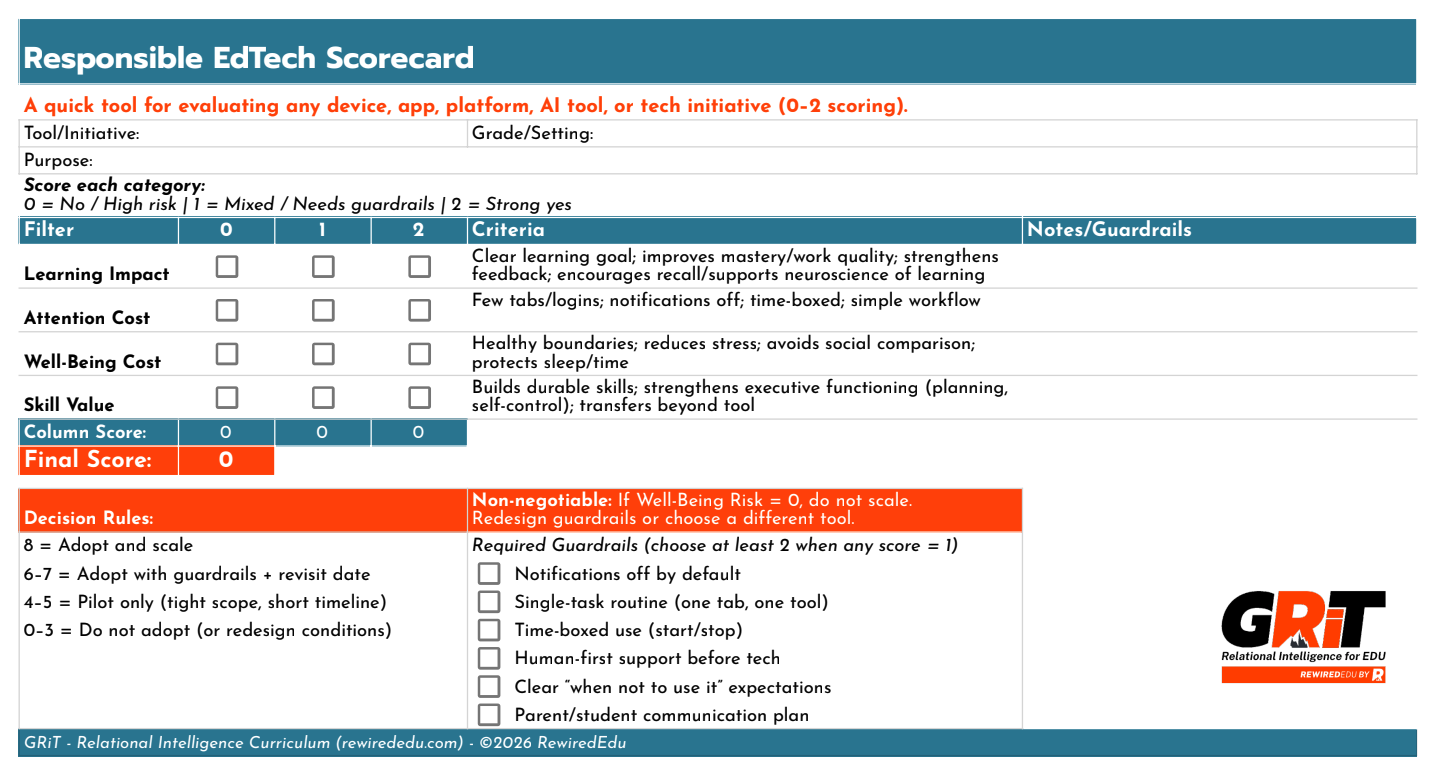
This scorecard is a quick, repeatable way to evaluate any device, app, platform, AI tool, or tech initiative using a simple 0–2 scoring across four filters.
It is not meant to replace a full procurement process or a privacy/security review. It is meant to help decision makers answer a different set of questions that often get overlooked:
- What is the attention cost of this tool?
- What is the well-being cost of scaling it?
- Does it build durable skills that transfer beyond the tool?
- Does it align to the neuroscience of learning, not just engagement?
Why this matters right now
We’re seeing more attention on the unintended consequences of technology on youth. Thought leaders like Jonathan Haidt and Jared Cooney Horvath have helped elevate this conversation, and we are watching schools, states, and countries tighten policies, especially at younger ages.
I’m not arguing for “all tech” or “no tech.” I’m arguing for responsible tech, with clear decision rules and guardrails.
The Responsible EdTech 4-Filter Scorecard
The scorecard uses four filters:
- Learning Impact: Does the tool have a clear learning goal, improve mastery/work quality, strengthen feedback, and encourage recall aligned to how learning actually works?
- Attention Cost: Does it keep the workflow simple, minimize tabs/logins, reduce notifications, and support time-boxed use?
- Well-Being Cost: Does it support healthy boundaries, reduce stress, avoid social comparison, and protect sleep and time?
- Skill Value: Does it build durable skills, strengthen executive functioning (planning and self-control), and transfer beyond the tool?
Each category gets a score:
0 = No / High risk
1 = Mixed / Needs guardrails
2 = Strong yes
The decision rules
This is where the scorecard becomes useful.
- Non-negotiable: If Well-Being Cost = 0, do not scale. Redesign guardrails or choose a different tool.
- 8: Adopt and scale
- 6–7: Adopt with guardrails + revisit date
- 4–5: Pilot only (tight scope, short timeline)
- 0–3: Do not adopt (or redesign conditions)
That “well-being non-negotiable” is intentional. It forces the conversation beyond convenience.
Guardrails you can actually use
When any category scores a 1, the scorecard prompts you to choose guardrails, such as:
- Notifications off by default
- Single-task routine (one tab, one tool)
- Time-boxed use (start/stop)
- Human-first support before tech
- Clear “when not to use it” expectations
- Parent/student communication plan
This is where schools win. Most tools are not “good” or “bad.” The outcome depends on conditions.
How to use the scorecard in 10 minutes
Here’s a workflow I recommend:
- Name the tool and the purpose (one sentence).
- Score the four filters quickly (0–2).
- If anything is a 1, select guardrails.
- If well-being is a 0, stop and redesign the plan.
- Set a revisit date if you pilot or adopt with guardrails.
If you want to make this even stronger, do it with a small group: tech director, an instructional coach, a classroom teacher, a counselor, and an administrator. You will surface blind spots fast.
Why this connects to GRiT and Relational Intelligence
At RewiredEdu, our work through GRiT is centered on Relational Intelligence and the neuroscience of learning. That matters here because the most important outcomes are not just test scores or task completion. The most important outcomes are student capacities:
- attention management
- executive functioning
- self-regulation under stress
- healthy technology habits
- communication, empathy, and repair
- skill transfer for career, college, and life
The scorecard is a practical extension of that belief: tools should serve humans, not replace them, and “efficient” should never mean “expensive” in attention or well-being.
Download the scorecard (free beta)
➡️ You can download the scorecard to try yourself at this link.
A partner-style invitation
If this tool resonates, it’s likely because you’re asking the right questions. The schools that thrive in the next decade will not be the ones with the most technology. They’ll be the ones with the clearest purpose, the healthiest boundaries, and the strongest student skill development.
If you’d like to compare notes or explore how GRiT supports this work across student development, culture, and durable skills, I’m happy to connect.
Stay connected with news and updates!
Join our mailing list to receive the latest news and updates from our team.
Don't worry, your information will not be shared.